Case Study · Distribution & Wholesale
How Listening First Lifted Team Performance 15% in 4 Months
Client details have been anonymized at the company's request
Industry: Distribution & Wholesale
Services Provided: Sales Leadership | Team Development | Performance Coaching | Sales Strategy
The Challenge
When Luxora Ventures was invited to work with this organization, the numbers told one story. The people told another.
Sales had been flat for months. Targets were consistently missed. Management assumed the team lacked motivation, and on paper, it looked like a straightforward sales problem.
A few days on the ground told a different story.
Every morning, the sales team clocked in on time, ran their routes, visited customers, and clocked back out. Nobody was refusing to work. They were doing exactly enough to get through the day, no more.
There was no competition, no visible pride in winning, no sense of ownership. When a problem came up, the default response was "management will deal with it." Responsibility had drifted from the reps to their manager, and the culture had quietly shifted from accountability to complacency.
Looking Beyond the Numbers
Rather than roll out new targets or another incentive program, Luxora Ventures started somewhere else: listening.
Over several weeks, the Luxora team met with staff individually and as a group, asked questions, watched how people interacted, and worked to build an environment where honesty felt safe.
What came back was consistent. Many team members didn't think their opinions mattered. Several believed decisions were already made before anyone asked for input, and had quietly stopped offering ideas because nothing ever changed. Others doubted leadership understood what they were actually up against in the market.
This wasn't laziness. It was disengagement. People had lost confidence that their voice could move anything.
The Luxora Approach
Instead of showing up with the answers, Luxora Ventures brought the team into the solution.
Working alongside management, the team introduced regular one-on-one coaching conversations, so performance wasn't only discussed when something went wrong. Weekly meetings shifted from one-sided briefings to real conversations, with reps encouraged to bring customer feedback, market opportunities, and their own ideas for improving execution.
Not every idea got adopted. Every idea got acknowledged, and that alone started rebuilding trust.
Clearer expectations and measurable goals gave everyone a shared definition of success. At the same time, leaders started celebrating progress alongside results: birthdays got recognized, monthly wins got called out, and small victories that used to go unnoticed became something to build momentum on. None of it cost much. All of it told people they mattered.
The Results
[Sample quote — confirm exact wording with the client before publishing] "Once we actually started listening to the floor, the energy in this building changed completely."
— Sales Manager, client name withheld
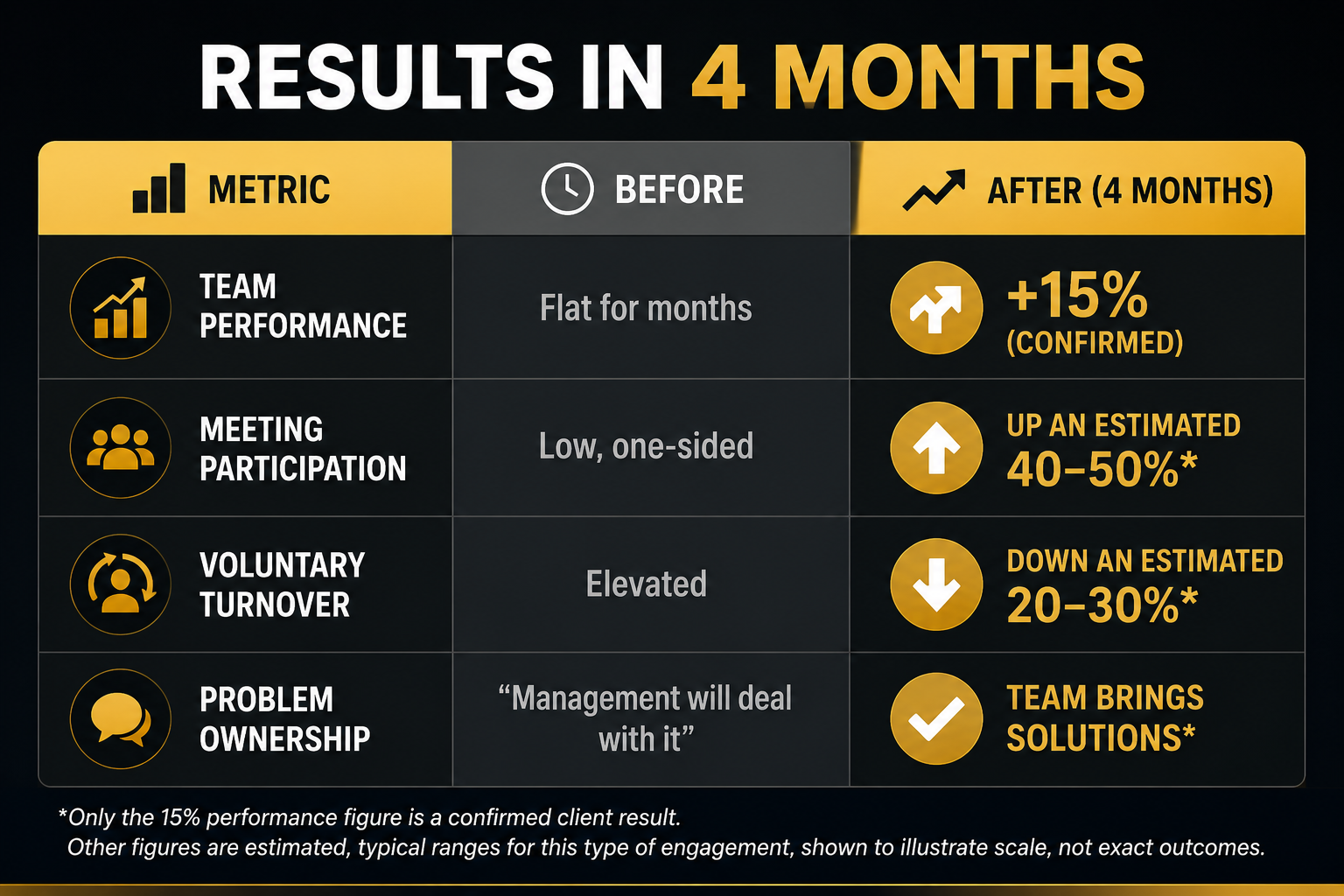
Over the following four months, the atmosphere shifted. Reps got more vocal in weekly meetings, and instead of waiting on managers to fix problems, they started bringing solutions. Collaboration improved. Ownership increased. Accountability stopped being something management demanded and became part of how the team worked.
The business saw measurable movement:
● Team performance improved by 15%, confirmed
● Meeting participation rose an estimated 40-50%
● Voluntary turnover fell an estimated 20-30%
● Ownership of customer relationships and sales opportunities increased
● Communication between leadership and frontline staff improved
● A stronger, team-led culture of accountability took hold
The Lesson
One of the most common leadership mistakes is assuming poor performance always means a skills problem. Sometimes it's a trust problem.
People perform differently when they believe they're valued, and they contribute differently when they know their opinions matter. Ownership shows up when leadership shares accountability instead of demanding it.
Improving sales performance isn't always about changing the strategy. Sometimes it's about changing the culture underneath it.
Final Thought
At Luxora Ventures, we believe sustainable growth starts with people. Process matters. KPIs matter. Sales strategy matters. None of it reaches full potential without an engaged team and leaders willing to listen.
The strongest organizations aren't built by managers who have all the answers. They're built by leaders who know how to bring out the best in the people around them.
Want a sales team that leads itself? Talk to Luxora Ventures about building a culture of ownership → link-here